
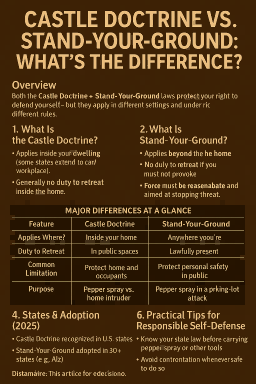
Castle Doctrine vs. Stand-Your-Ground: What’s the Difference?
Published on SelfDefense.fun · Legal Guide on U.S. Self-Defense Law
Overview
Both the Castle Doctrine and Stand-Your-Ground laws protect your right to defend yourself—but they apply in different settings and under different rules. Understanding the differences helps you know when and where force can be used lawfully, and how duty to retreat affects your rights.
1) What Is the Castle Doctrine?
The Castle Doctrine is based on the idea that your home is your castle. If an intruder unlawfully enters your dwelling, you may use reasonable force, including deadly force, to defend yourself and others—provided you reasonably believe an imminent threat exists.
- Applies inside your dwelling (some states extend to car/workplace).
- Generally no duty to retreat inside the home.
- Force must remain reasonable and necessary, not punitive.
- You must reasonably believe there is imminent danger.
2) What Is Stand-Your-Ground?
Stand-Your-Ground extends similar protection beyond the home. It allows you to use reasonable defensive force in places where you are lawfully present, without a duty to retreat.
- Applies in public spaces (streets, parking lots, stores).
- No duty to retreat if you face an imminent threat.
- You must be lawfully present and not the aggressor.
- Force still must be reasonable and aimed at stopping the threat.
3) Major Differences at a Glance
| Feature | Castle Doctrine | Stand-Your-Ground |
|---|---|---|
| Applies Where? | Home (sometimes car/workplace) | Anywhere you’re lawfully present |
| Duty to Retreat | No duty inside home | No duty in public |
| Common Limitation | Intruder must unlawfully enter | You must not provoke the incident |
| Purpose | Protect home and occupants | Protect personal safety in public |
| Example Tool | Pepper spray vs. home intruder | Pepper spray in a parking-lot attack |
4) States & Adoption (2025)
Castle Doctrine: Recognized in nearly all U.S. states.
Stand-Your-Ground: Adopted in 30+ states (e.g., FL, TX, GA, AZ). Some states combine both: Castle at home + Stand-Your-Ground in public.
5) Common Misunderstandings
- Myth: Stand-Your-Ground lets me fight anyone who threatens me.
Truth: It applies only to imminent threats and if you’re not the aggressor. - Myth: Castle Doctrine is a free pass to use deadly force.
Truth: Force must be proportionate and necessary. - Myth: All states use the same rules.
Truth: Definitions and procedures vary by state.
6) Practical Tips for Responsible Self-Defense
- Know your state law before carrying pepper spray or other tools.
- Avoid confrontation whenever safe to do so.
- Use only necessary force to stop the threat.
- Call 911 immediately after any defensive action.
- Cooperate respectfully with law enforcement.
Related Guides
- Reasonable Force Explained: Proportion, Necessity, and Retreat
- Carrying Pepper Spray: Legal Responsibilities and Limits
- After a Self-Defense Incident: What to Say (and Not Say)
Disclaimer: This article is for educational purposes only and does not constitute legal advice. Always check your state and local laws before relying on any self-defense doctrine.
Leave a Reply
You must be logged in to post a comment.